

Why this matters
The Women in Electron Microscopy (WeM) conference, held at Forschungszentrum Jülich in October 2025 for the first time, aimed to increase women’s visibility in electron microscopy (EM). As part of this initiative, we examined women’s representation among invited speakers at selected international EM conferences and surveyed the EM community to explore demographics, career experiences and perceived barriers to career progression – and the results were striking.
What next
We are continuing this work to better understand career experiences and barriers across the EM community—and how they evolve over time.
Help us take the next step by completing our new survey. We welcome participation from people of all genders, career stages and research fields within electron microscopy. Your perspective will help us identify where support is needed and inform efforts towards a more inclusive EM community.
Please share it with your colleagues and networks to help us reach a broader cross-section of the community.
What we found in 2025
Career experiences
About three quarters reported (major) career obstacles. Caregiving responsibilities, institutional gender bias and limited access to mentorship were each reported by more than 15% of respondents.
Different perspectives
Reported barriers varied across gender, career stage and geographical context.
Community demographics
The survey received 425 responses; 55.7% identified as female and 41.7% as male.
Research fields
Approximately 75% of respondents worked in life sciences and 15% in materials science.
Speaker representation
Women accounted for 12–42% of invited speakers at selected EM conferences between 2022 and 2025, with most conferences reporting 12–30%.
The full results will be published soon, and a link will be added here once they are available.
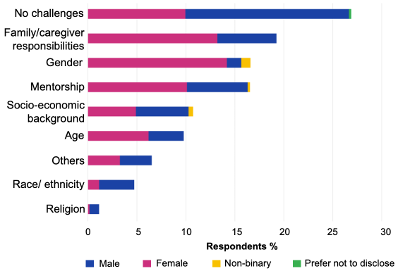
Distribution of career barriers reported by survey respondents (n= 425)
Bars show the percentage of total respondents reporting specific career challenges, segmented by gender identity: male (blue), female (magenta), non-binary (yellow/orange), and prefer not to disclose (green). Barriers are arranged from the most frequently to the least frequently reported