
Cameca LEAP 4000X HR
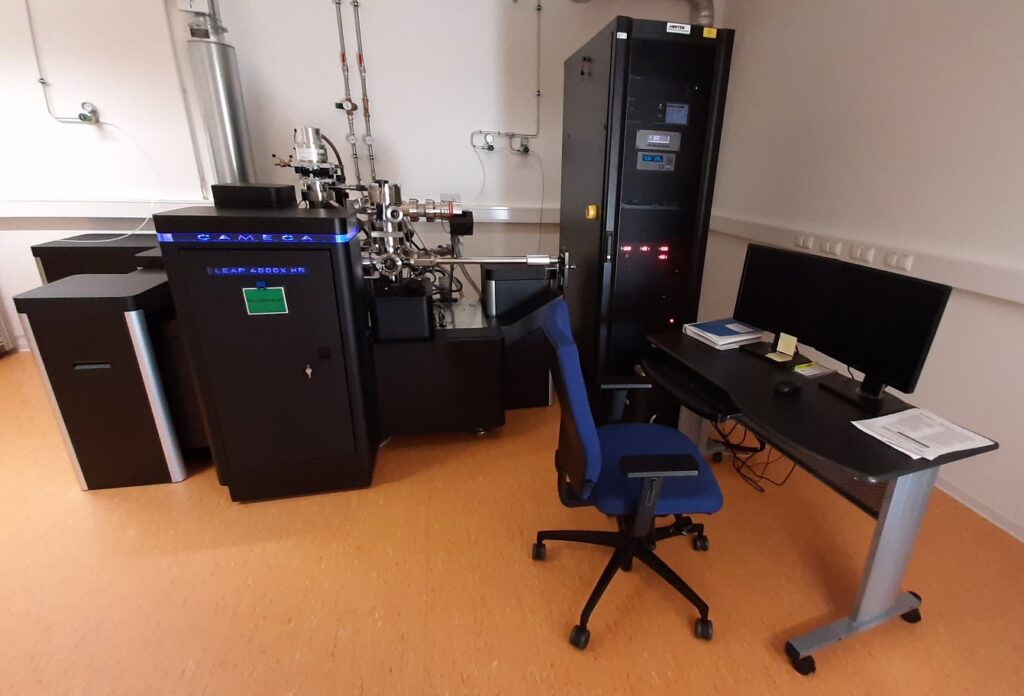
The Cameca LEAP 4000X HR is an advanced atom probe tomography (APT) system designed for quantitative three-dimensional elemental analysis at near-atomic resolution.
APT analysis requires the preparation of needle-shaped specimens, typically with cross-sectional diameters of 100–300 nm. During measurement, atoms are removed from the specimen surface one by one by field evaporation induced by a high standing voltage combined with ultrashort voltage or laser pulses. The evaporated ions are identified using time-of-flight mass spectrometry, providing very high elemental and isotopic sensitivity across the entire periodic table. While APT delivers extremely detailed compositional information, it usually does not provide crystallographic structure information and is therefore highly complementary to electron microscopy techniques, particularly transmission electron microscopy (TEM).
The LEAP 4000X HR system is equipped with a reflectron to improve mass resolution and field-of-view, as well as an ultraviolet laser enabling the analysis of non-conductive materials. A position-sensitive detector based on a multichannel plate allows reliable detection of single ions, including multi-hit events. Since atoms are field-evaporated and detected with essentially equal probability, compositional quantification can be performed without the need for external standards or sensitivity factors. Specimens are typically prepared using gallium or plasma focused ion beam (FIB) lift-out techniques, enabling targeted extraction of microscopic regions of interest.
Typical Applications and Limitations of Use
The Cameca LEAP 4000X HR is widely used for nanoscale compositional analysis of materials where precise chemical information is required. Typical applications include the investigation of elemental segregation at grain boundaries and interfaces, mapping the distribution of dopants in semiconductor and nanostructured materials, characterization of nanoscale clustering and precipitation phenomena, and measurement of local compositions within small volumes of complex materials.
A broad range of material classes can be analyzed, including metals, semiconductors, ceramics, and many dielectric materials. In correlative workflows, specimens can be analyzed first using transmission electron microscopy and subsequently by atom probe tomography, enabling the combination of structural and chemical information from the same microvolume.
Certain limitations arise from specimen preparation requirements and material properties. APT requires the fabrication of dense needle-shaped specimens with lengths of approximately 1–2 µm, which can make the analysis of nanoparticles, nanoporous materials, or mechanically weak materials challenging or infeasible. Most organic and especially biological materials are generally not suitable for APT analysis, although exceptions may exist. In the current configuration, analysis of hydrogen is not supported.
Sample Environment
Measurements with the Cameca LEAP 4000X HR are performed under ultrahigh vacuum (UHV) conditions at pressures below 1 × 10⁻¹⁰ mbar, ensuring minimal contamination during field evaporation. Samples are cooled to cryogenic temperatures in the range of 20–50 K, which prevents thermal surface migration of atoms.
During operation, specimens are subjected to strong electrostatic fields required for field evaporation. As a result, materials must possess sufficient mechanical strength to withstand the electrostatic stress without premature fracture. The combination of ultrahigh vacuum, cryogenic temperatures, and high electrostatic fields defines the operational sample environment and determines material compatibility.
Technical Specifications
| Parameter | Specification |
|---|---|
| Operating Modes | Voltage or laser pulsing |
| Laser Type | Ultraviolet laser |
| Laser Wavelength | 355 nm |
| Laser Pulse Duration | 12 ps |
| Laser Pulse Energy | 0.01–300 pJ |
| Maximum Pulse Repetition Rate | 200 kHz (voltage), 250 kHz (laser) |
| Typical Probed Volume | 100 × 100 × 100–800 nm³ |
| Detection Efficiency | 36 % |
| Spatial Resolution | ~1 nm (ion positioning accuracy) |
| Mass Resolution | m/Δm ≈ 1000 |
| Detection Sensitivity | ~10 atomic ppm |
| Data Output | 3D ion cloud with (x, y, z) position and mass-to-charge ratio |
| Vacuum Conditions | Ultrahigh vacuum (< 1 × 10⁻¹⁰ mbar) |
| Operating Temperature | 20–50 K |
| Specimen Geometry | Needle-shaped |
| Typical Specimen Diameter | 100–300 nm |
| Typical Specimen Length | 1–2 µm |
| Detector Type | Delay-line with position-sensitive multichannel plate |
| Special Features | Reflectron ion optics |