
Zeiss Gemini SEM 460
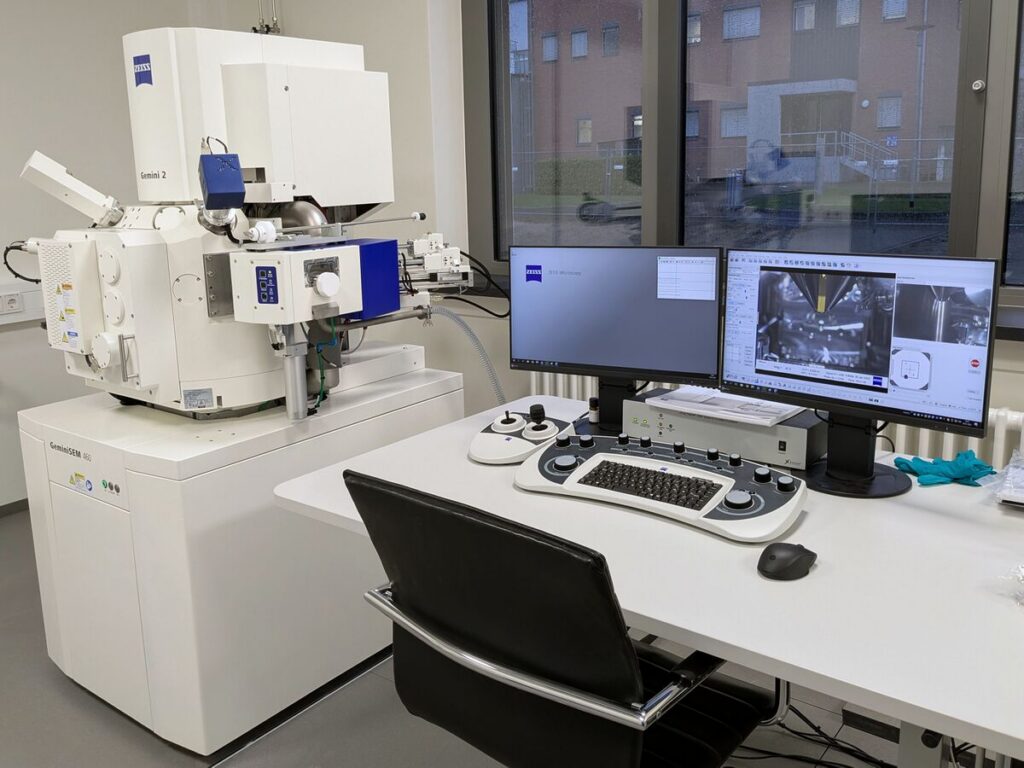
The Zeiss Gemini SEM 460 is an environmental scanning electron microscope (ESEM) designed for high-resolution imaging and advanced multi-modal materials characterization. The system provides a flexible platform combining conventional SEM imaging with analytical and correlative techniques, including energy-dispersive X-ray spectroscopy (EDX), electron backscatter diffraction (EBSD), atomic force microscopy (AFM), Raman spectroscopy, cathodoluminescence (CL), 4D-STEM, in situ heating and gas experiments.
The microscope was installed in January 2025, and several additional detectors and modules have been integrated since installation. The Oxford EDX and EBSD systems were installed on 14–15 April 2025, followed by the installation of the Doublefox AFM on 28 April 2025. A Kammrath & Weiss heating and transfer module was added on 17 July 2025, and the Renishaw InLux Raman interface was installed on 26–27 August 2025. Further extensions and optimizations of the system are ongoing.
Sample Environment
The Zeiss Gemini SEM 460 provides a versatile sample environment supporting both conventional high-vacuum operation and environmental imaging. The environmental NanoVP mode allows operation at chamber pressures of up to 500 Pa, enabling the investigation of non-conductive or beam-sensitive samples while reducing charging effects.
The instrument supports controlled in situ and environmental experiments through several integrated modules. A Kammrath & Weiss heating stage and transfer module enables heating experiments at temperatures of up to 1050 °C, supporting studies of thermally induced structural or chemical changes. A gas injection system (CC-GIS) allows the controlled introduction of selected gases, including N₂, O₂, CH₄, CO₂, and H₂, with some gases requiring additional safety evaluation.
Additional environmental and analytical monitoring is supported by a Pfeiffer mass spectrometer for residual gas analysis. The system also enables correlative measurements through integration with the Doublefox AFM and the Renishaw inLux™ SEM Raman interface, expanding the range of experimental environments and characterization methods available.
The available sample environment depends on the installed detectors and selected experimental configuration. Working distance requirements, pressure limits, and temperature constraints must be considered during experimental planning. Users should ensure that samples are vacuum-compatible and stable under electron beam exposure.
Technical Specifications
| Parameter | Specification |
|---|---|
| Acceleration Voltage | 20 V – 30 kV |
| Resolution (STEM) | 0.6 nm at 30 kV |
| Resolution (SE) | 0.7 nm at 15 kV |
| Low Voltage Resolution | 1.1 nm at 1 kV / 500 V |
| Resolution at Elevated Pressure | 1.0 nm at 30 Pa and 15 kV |
| Vacuum Modes | High vacuum and NanoVP low-vacuum mode |
| Maximum Chamber Pressure | Up to 500 Pa |
| STEM Detectors | BF, DF, ADF, HAADF, segmented |
| 4D-STEM Capability | DigiPix camera with custom stage |
| EDX System | Oxford UltimMax 170 mm² |
| EBSD Detector | Oxford EBSD |
| Recommended Working Distance | 10 mm (EDX), 15–25 mm (EBSD) |
| AFM System | Doublefox AFM |
| Heating Stage | Kammrath & Weiss heating/transfer module |
| Maximum Heating Temperature | Up to 1050 °C |
| Raman System | Renishaw inLux™ interface with Virsa™ analyser |
| Residual Gas Analysis | Pfeiffer mass spectrometer |
| Gas Injection System | N₂, O₂, CH₄, CO₂, H₂ (subject to approval) |
| Additional Components | Fast beam blanker |